One verifier in three roles, and seven claims around it that lied. A follow-up to I Didn’t Write the Code, I Wrote the Grader.
- Repo: github.com/nsega/mini-reasoning-pipeline
- Recorded runs: docs/runs/
My last post ended on a question I couldn’t answer: if the agent can grade itself, who grades the grader, and how much heavier does that make the responsibility of the person who writes the rubric?
This post is a small answer from the other side. I built mini-reasoning-pipeline, the capstone of a three-week study lab built around Sebastian Raschka’s Build a Reasoning Model (From Scratch): a minimal pipeline that trains Qwen3-0.6B with GRPO on a frozen 50-problem MATH-500 subset. Its design has one idea. A single verifier, which extracts a final answer and checks it for equivalence with sympy, plays three roles: it grades the baseline eval, it is the reward during training, and it grades the validation eval. The roles differ only in how strictly they extract an answer. The reward accepts only an answer written in \boxed{}. The two evals also rescue a bare final number.
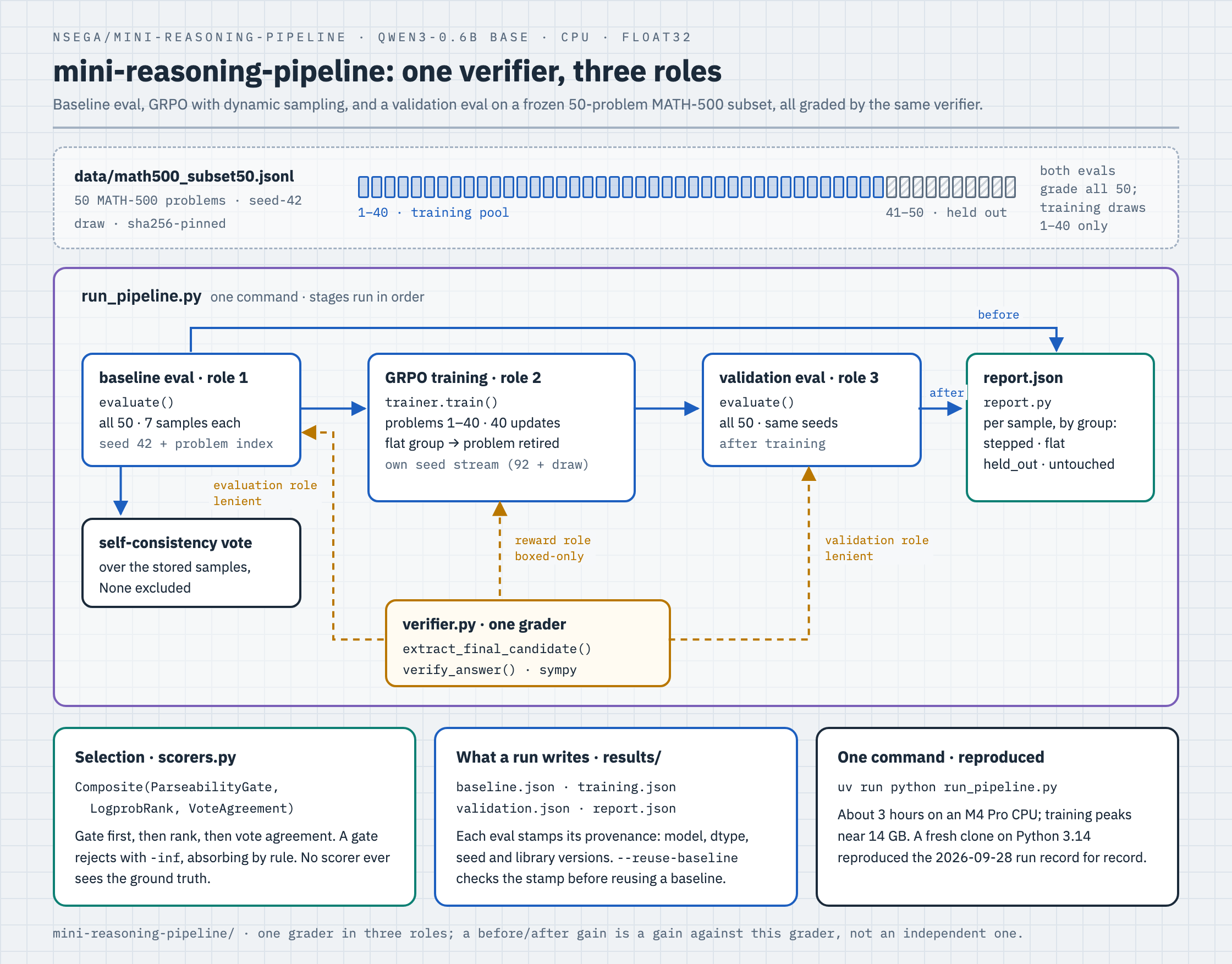
The pipeline. The dashed amber edges are the verifier’s three roles. Training draws only problems 1 to 40, and both evals grade all 50. Source: docs/pipeline.html.
None of the seven came from the grader. Every one came from somewhere else: a library default, an extrapolation, a metric, a run’s noise, a design formula, a stale figure, a claim nobody had audited. I didn’t re-validate the verifier during this work, so read that as a statement about where the seven came from, and nothing stronger.
I built this with Claude Code, as I built RouteCause, and that matters here more than usual. The agent’s own reasoning was behind two of the seven, and two more sat in AI-assisted commits from before this work began. The agent also made most of the catches, one of its own mistakes included. One fell only to a reviewer agent in a fresh context with no stake in the code. Each lesson says who.
1. The training that rounded to nothing
The first full run was partway through training when I asked the agent for a status update. It noticed the process holding 3.67 GB, where the README documented a float32 training peak of 8.6 GB.
The model had loaded in bfloat16. transformers 5 defaults to the checkpoint’s own dtype, Qwen3 ships bfloat16, and the code never asked for anything else. pyproject.toml pinned transformers>=4.51, which admitted both the old float32 default and the new one, and the lockfile had installed transformers 5 since the first commit. Nothing drifted. The model had loaded in bfloat16 all along, while the README described float32.
At a learning rate of 1e-6 that is fatal, quietly. Adam’s per-step update is about 1e-6, an order of magnitude below the smallest change bfloat16 can represent at these weights, about 1.5e-5. A test on a real weight slice made it concrete: after 20 Adam steps, 1,030 of 65,536 values had moved in bfloat16, against 65,526 in float32. The optimizer would have stepped, reported real gradient norms, and rounded nearly every update away. I stopped the run before it finished training, so the evidence is a mechanism and a measurement rather than a recorded no-op.
Where the lie came from: a library default the code never overrode, behind a pin loose enough to hide it.
What caught it: the agent, reading memory that didn’t match the docs.
Fix: load in float32 explicitly (#12) and pin transformers to the tested major (#18).
Hold on to that 8.6 GB. It comes back in lesson 6.
2. The estimate from the first two rows
The README said an eval would take roughly 40 seconds per problem, about 35 minutes for the subset, a figure an earlier AI-assisted commit had taken from timing the first two problems. The agent timed the same two problems again, got about the same number, and told me the estimate held. It had checked the estimate against its own source.
The float32 baseline eval took 56 minutes 56 seconds: 68 seconds per problem. The first two problems were not the eval. Their samples averaged 472 characters against the subset’s 990. The first drew the shortest answers of all fifty, and the subset leans hard: generation length tracks difficulty, from about 666 characters at level 1 to 1,187 at level 5, and 36 of the 50 problems sit at levels 4 and 5.
Where the lie came from: an extrapolation from the first two problems, made in an earlier AI-assisted commit and repeated by the agent.
What caught it: the wall clock of a real run, which the agent reported against its own estimate.
Fix: measured timings in the README, with the reason the average holds (#12, updated in #17). Time a full run, not the first rows.
3. The decline that wasn’t
After the dtype fix, the first float32 run finished and the headline said training had hurt: accuracy fell from 0.320 to 0.240, 16 problems to 12.
That headline counts one selected answer per problem, so 50 coin flips, with the selection scorer’s own variance on top of the model’s. Only six problems changed outcome, five lost and one gained, and a McNemar test on those six gives p = 0.219. Every eval stores all seven samples per problem, so each problem can be scored as a share out of seven instead of a single right or wrong. Scored that way, the same records went the other way: 0.160 to 0.186 on the eval’s grader, 0.140 to 0.163 on the boxed reward. Neither direction was significant, on a test that still pairs problem with problem, since one problem’s seven samples rise and fall together. The decline was never a finding.
The noise floor is wide in a second way. The same code at bfloat16, with the same seed and subset and no training at all, had scored 0.400 against float32’s 0.320. Eight points from numerics alone.
Where the lie came from: the noisiest available metric, read as the headline.
What caught it: the agent, when I asked it to re-examine the result: scoring every stored sample and splitting the comparison by what training did to each problem (#15).
4. The gain that wasn’t
The split was where it got interesting. Training had stepped on 23 problems, skipped 17 whose groups came out flat, and never drawn the last 10. On the 23 it rose 6.2 points on the boxed reward, at p = 0.10, while the flat problems didn’t move. That is exactly what training working where it got gradient would look like. The run note called it suggestive, not established, and that hedge turned out to be the most useful sentence in it.
The next run fixed what the first one wasted. The budget counted 40 real updates instead of 40 draws, and a problem whose group came out flat was retired, so later passes went to the problems that gave gradient. Its baseline came out identical to the first run’s, record for record, so the two runs shared the exact same before-half. They stepped on different problems, 23 and 20, so the fair comparison is the 17 that both stepped on. On those 17, the first run moved only +3.4 points, and the second −3.4. Nearly doubling the updates flipped the sign. That is what noise looks like.
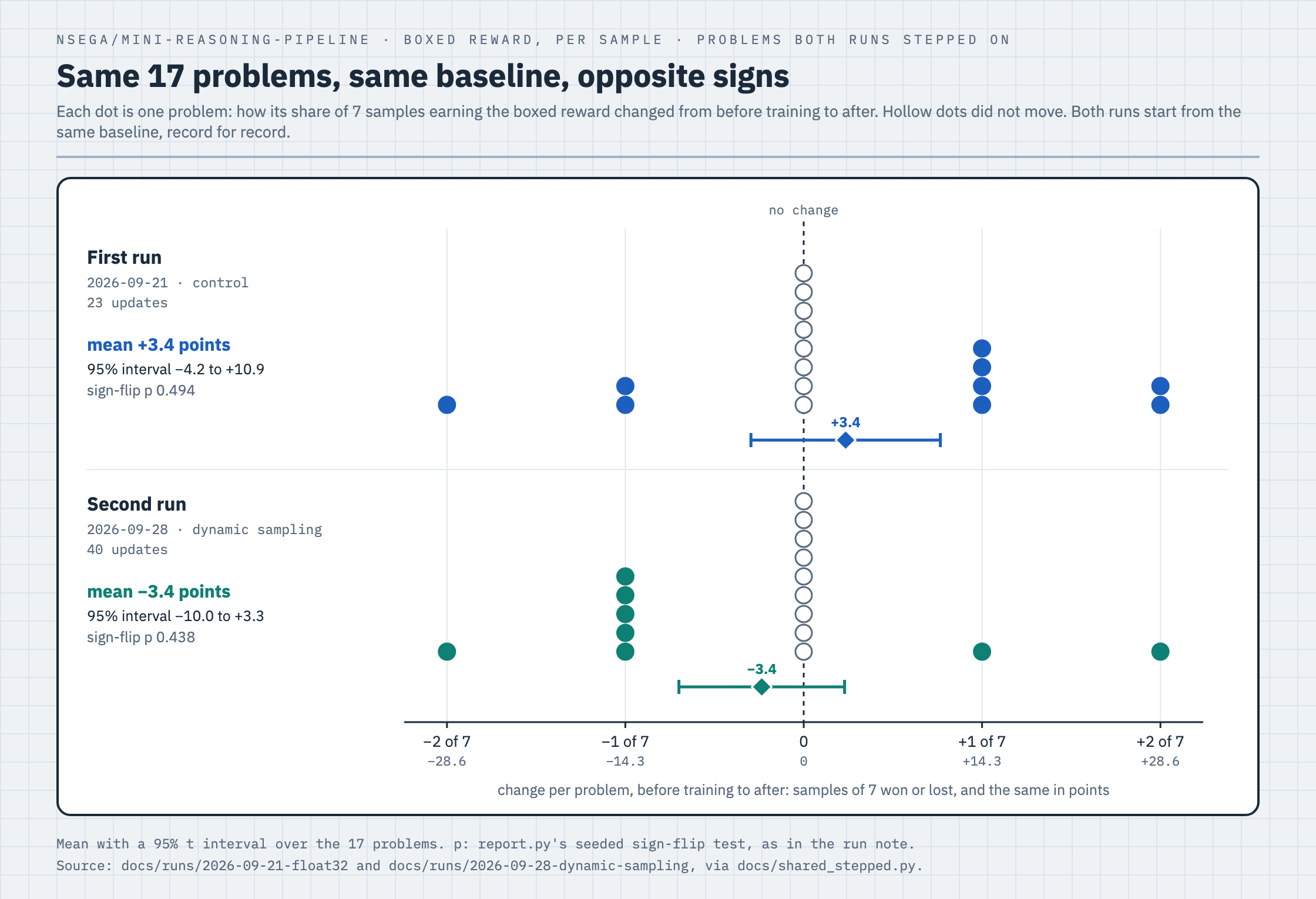
The 17 problems both runs stepped on. Eight and nine of them never moved. The rest moved by one or two samples of seven, in both directions, in both runs. Both intervals cross zero. Source: docs/shared_stepped.py, which computes the figure from the two committed runs.
The held-out problems could never have settled it. From the first run’s per-problem variance, a held-out group of k problems detects at 80% power an effect of about:
| held-out problems | smallest detectable effect |
|---|---|
| 10 | 10.9 points |
| 20 | 7.7 points |
| 50 | 4.9 points |
The trained problems moved 6.2, and a generalization effect is normally smaller than the effect on the training problems themselves. With ten held out, the held-out group can show a direction and nothing more.
Where the lie came from: one run’s noise, read as a pattern.
What caught it: a replication that shared the baseline (#16), and the agent’s comparison of the two runs problem by problem (#17).
5. The seed that replayed the baseline
That second run needed training to be reproducible, so the agent’s design seeded each training draw d with seed + d. I approved it in the spec. It was implemented faithfully and every test passed.
The evals already seeded problem i with seed + i, through the same sampling call with the same prompt and settings. Training walks its pool in subset order, so on the first pass draw d is problem d, drawn with the baseline eval’s own seed, prompt and settings. Until the first update moved the weights, that replayed the eval’s samples exactly, so which problems got retired was decided largely on the eval’s own draw. The design had explicitly rejected that pre-filter, because choosing training problems by the eval’s own samples makes the after-scores regress toward the mean on the very groups the report compares. The trained group’s before/after inherited a coupling the first run never had, and nothing in the output would have shown it.
Where the lie came from: the agent’s seed formula, signed off by me.
What caught it: the final review of the branch, by a reviewer agent in a fresh context that had the repository, the spec and the plan, and none of the conversation behind them. The agent confirmed the finding against the source before fixing it.
Fix: training’s seed stream now starts past every eval seed (#16), and the run records the seed it used (#18).
6. The 14 GB the README called 8.6
The first float32 run was killed by a low-memory watchdog at exactly the training stage. Measured properly, through the first optimizer updates of a short run, training peaks at about 14 GB: the weights, gradients and Adam’s state account for about 9, and the forward and backward pass over each rollout comes on top. The README’s 8.6 had never been re-measured, and the probe behind it had loaded the model the way lesson 1 describes, without asking for a dtype. It was most likely a bfloat16 number labeled float32.
That is the 8.6 from lesson 1. A wrong number, quite possibly produced by the same wrong configuration, caught that configuration, because 3.67 GB sat far below both the documented 8.6 and the true 14. I’ll take the catch, but I wouldn’t build on it.
Where the lie came from: a figure from an earlier AI-assisted commit, most likely measured in bfloat16, that nobody had re-measured.
What caught it: a watchdog crash, then the agent’s measurement (#18).
7. The provenance claim
Since the AI-written scaffold commit, the README had said all the pipeline code was self-written, under the lab’s rule that only self-written code migrates into the capstone. Before publishing, the agent flagged the claim and audited the git history, which disagreed. All four implementation commits of grpo.py carry a Claude co-author trailer. report.py and its tests are AI-written. And a review session flagged a comment in verifier.py that history alone couldn’t resolve, so the agent diffed the function against the private lab repository: _normalize_text is byte for byte a Claude-written lab function that my own lab note said had to be rewritten by hand before migrating. It wasn’t.
Where the lie came from: a rule the scaffold stated as a fact, and one I never enforced.
What caught it: the agent’s audit of git history, then its byte diff against the lab.
Fix: the Provenance section now sets out the split module by module (#18, #22, #23). Both figures in this post were built with Claude too, and their sources say so. Claude also drafted this post’s prose, on an angle I chose, and I reviewed and approved the final text before publishing. This lesson is also this post’s disclosure.
What grades the grader
The result, for the record: with 40 real updates over 64 draws, nothing moved beyond noise, on the trained problems or the held-out ones. GRPO at this learning rate and budget does not measurably move this model on this subset. It’s a null result, and one measured carefully enough to trust.
One claim survived its check. A fresh clone of the repository on the same machine, on Python 3.14 where the run had used 3.13, following only the README’s one command, reproduced that three-hour run record for record: every baseline and validation record, all 64 training draws down to the gradient norms, and a byte-identical report. That is a same-hardware result. Floating-point math on a CPU can differ from one chip to the next, so I wouldn’t promise the same records on another machine.
| # | the claim | where it came from | what caught it |
|---|---|---|---|
| 1 | training stepped | a library default the code never overrode | a memory reading that didn’t match the docs |
| 2 | 40 seconds per problem | two short rows, scaled up | the wall clock |
| 3 | accuracy fell 8 points | the noisiest metric, read as the headline | scoring every sample, split by group |
| 4 | trained problems rose 6.2 | one run’s noise, read as a pattern | a replication sharing the baseline |
| 5 | training drew its own samples | the agent’s seed formula | a fresh-context reviewer |
| 6 | an 8.6 GB peak | a figure never re-measured | a crash, then a measurement |
| 7 | all pipeline code self-written | a rule stated as a fact | git history and a byte diff |
Read down the last column. Each lie fell to a check that didn’t share its context: a different resource, a different clock, a different metric, a different run, a different reviewer, a different instrument, a different repository. The agent ran six of those checks, one of them on its own extrapolation. Its other mistake, the seed formula, took a reviewer agent in a fresh context. Trusting the verifier more would have caught none of the seven.
The verifier itself never faced a check like that. Every before and after in this post is measured with it, so any gain here would be a gain against this grader alone. Grading it would take the same move: hand-checking a few dozen of its verdicts, starting where the lenient eval and the boxed reward disagree, and re-grading the stored records with an independent MATH grader. I haven’t run either.
So my answer to the last post’s question is less satisfying than I’d like and more useful. The person who writes the rubric is also responsible for the checks around it, the grader included, and the heavier part of that responsibility is making those checks independent: a context the lie can’t reach.
mini-reasoning-pipeline is open source. Repo: github.com/nsega/mini-reasoning-pipeline · Recorded runs: docs/runs/ · Previous post: I Didn’t Write the Code, I Wrote the Grader